Why a German Brand Chose a Cheaper Supplier—And What It Teaches Us About Custom Jewelry Packaging
How a German client's feedback after choosing a cheaper supplier highlights true value in custom jewelry packaging: why 100 sets cost more, when to use anti-tarnish foam, and why 500 sets is best.
When sourcing custom jewelry packaging with low MOQ, independent brand founders frequently face a difficult crossroads: should you prioritize the lowest initial unit quote, or invest in manufacturing transparency and engineering reliability?
A few days ago, we received a thoughtful closing message from Max, a brand founder based in Germany. After weeks of in-depth technical consultation—covering structural box templates, interior insert optimization, and Pantone color accuracy—his team ultimately decided to proceed with another supplier offering a significantly lower initial price.
Yet, what he wrote before closing the thread made all our efforts worthwhile:
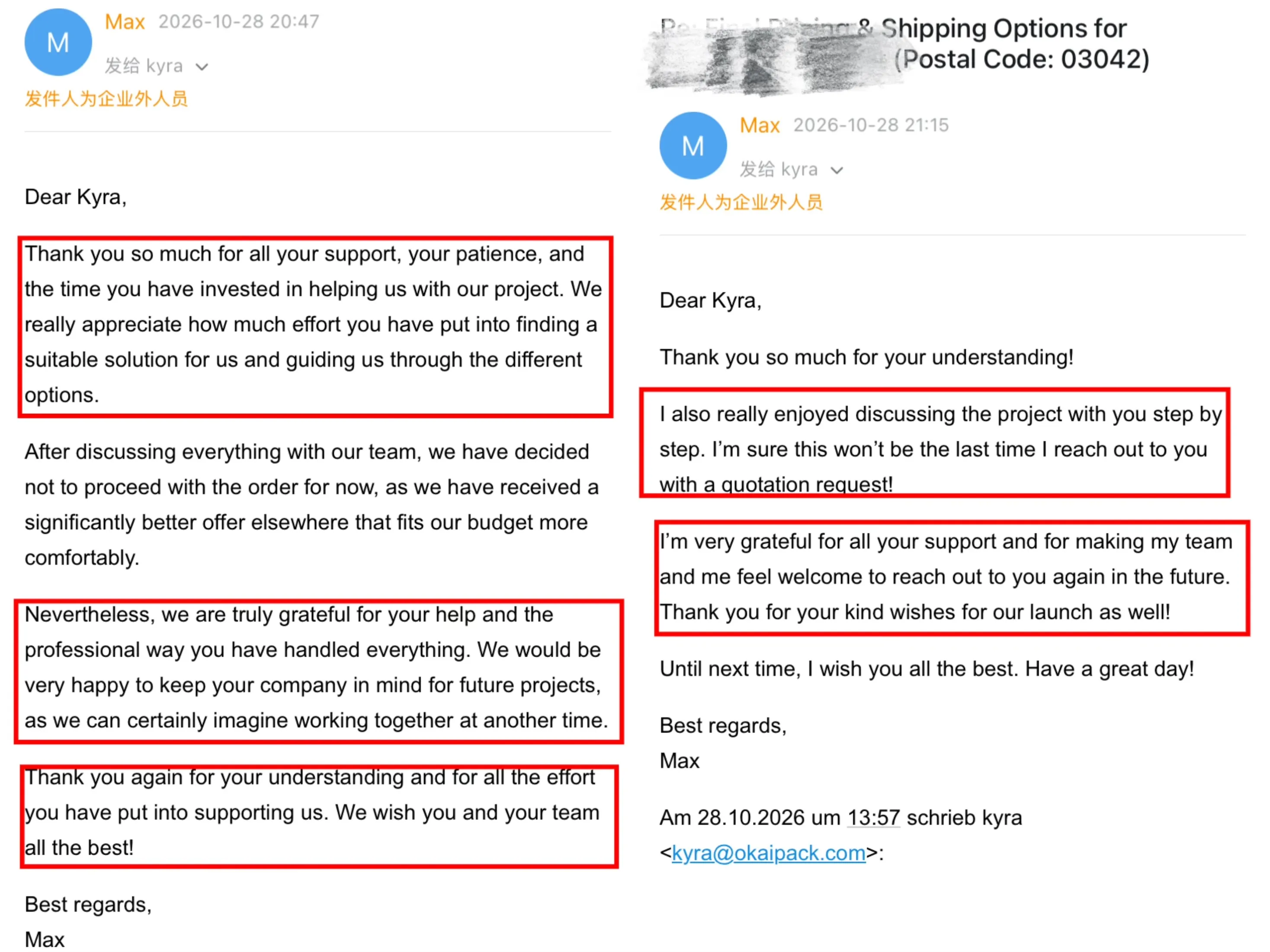
“Thank you so much for all your support, your patience, and the time you have invested in helping us with our project... Nevertheless, we are truly grateful for your help and the professional way you have handled everything. We would be very happy to keep your company in mind for future projects, as we can certainly imagine working together at another time.”
“I also really enjoyed discussing the project with you step by step. I’m sure this won’t be the last time I reach out to you with a quotation request!“
Caption: Genuine feedback from our German client. While we lost the order on price, earning his trust in our technical honesty and responsiveness means everything.
Losing an order on price is never easy, but messages like this reinforce our core philosophy: In custom packaging, we refuse to enter the "race to the bottom" by cutting invisible corners.
Here is what emerging jewelry and accessory brands should understand about the engineering realities and true costs behind custom jewelry packaging design and manufacturing.
Many low-quote vendors cut corners by using a generic, low-grade recycled sponge across all orders. Professional packaging engineering requires matching the insert formulation to the specific metal properties of your collection:
For 925 Sterling Silver Lines: Silver is vulnerable to atmospheric sulfur. For fine silver jewelry, we strictly recommend certified sulfur-free EVA foam inserts paired with neutral, acid-free lining paper to create an anti-tarnish jewelry packaging environment that prevents oxidation and surface blackening during transit and storage.
For Stainless Steel, Brass & Gold-Plated Pieces: Anti-scratch performance, firm structural support, and lint-free velvet lamination are the primary priorities. High-density standard EVA or high-elastic flocking foam delivers luxury aesthetics and reliable protection without inflating your development budget.
The Low-Cost Trap: Inferior workshops often use cheap industrial scrap foams with strong chemical adhesives. These emit volatile organic compounds (VOCs) that smell unpleasant upon unboxing and can corrode delicate plating over time.
2. The Truth About Low MOQ: Why 100 Sets Cost More & Why 500 Sets Is the Sweet Spot
Many emerging founders ask: "Why is the unit price for 100 sets significantly higher than 1,000 sets?"
Understanding the fixed industrial make-ready costs provides clarity:
100 Sets (Agile Market Testing): We fully support 100-set micro-runs to help designers validate concepts without dead inventory. However, fixed setup fees—such as CTP printing plates, laser cutting dies, custom mold adjustments, and machine calibration—are unavoidable. When spread across only 100 boxes, the per-unit amortized cost is inherently higher.
500 Sets (The High-ROI Sweet Spot): If you want the best balance between capital investment and unit economics, we strongly recommend 500 sets as your launch baseline. At 500 units, initial setup overheads are diluted across production, unlocking a substantial cost drop (often 30% to 45% lower per-unit cost compared to 100 sets) while maintaining luxury finishing.
Achieving luxury-grade packaging demands visual consistency across diverse materials—such as matte-laminated rigid boxes, satin dust bags, and printed cards.
Low-cost suppliers routinely skip 1:1 digital pre-press proofing and mechanical knife-line checks to save machine setup time. This frequently leads to misaligned hot-foil stamping, off-center screen printing, or magnetic closures that fail to snap shut properly.
At OKAI PACK Studio, our rule is simple: Zero production begins without your explicit sign-off on 1:1 scale digital engineering proofs.
Consistency & Integrity Build Long-Term Brands
A rock-bottom quote might save a few hundred dollars on your initial prototype invoice, but reliable materials, verified structural durability, and clear cross-border communication protect your customer unboxing experience.
We wish Max and his brand team absolute success with their upcoming market debut! When his collection expands and requires elevated craftsmanship and dependable execution, our workshop doors remain wide open.
Planning your next jewelry or accessory packaging project?
Whether you are sourcing custom rigid drawer boxes, anti-tarnish protective inserts, or custom-printed satin pouches, reach out to our team at OKAI PACK for transparent engineering guidance and itemized quotations tailored to your exact launch stage.
Read next
More from the journal
Keep readers moving through related announcements, stories, and field notes.
A verified sizing guide to custom wig packaging for boutique hair brands. Discover standard dimensions, freight weight economics, and snag-free specs for 18–30" units.
Learn how independent jewelry designers and DTC boutique brands use Quiet Luxury aesthetics, FSC-certified paper, and reusable pouches to elevate perceived value without high MOQs.
Planning a Kickstarter tarot or oracle card project? Learn how to choose the right paper GSM, gilded edge finishes, and rigid keepsake boxes to create a luxury collector deck.